AI-Native SaaS
UpSkalr: AI-Native SaaS Platform
A complete SaaS platform with three integrated AI subsystems, 46-table database architecture, enterprise security, and Stripe subscription management. Built as a solo operator to prove what’s possible when an experienced architect uses AI development tools.

Jonathan Lasley
Fractional AI Director
3
AI Subsystems
Real-time coaching, voice transcription, scheduled intelligence
46 tables
Database Architecture
100+ RLS policies, 53 custom functions, 21 triggers
Live
In Production
Active users with Stripe subscription management
The Challenge
Can a Solo Operator Build Enterprise-Grade SaaS?
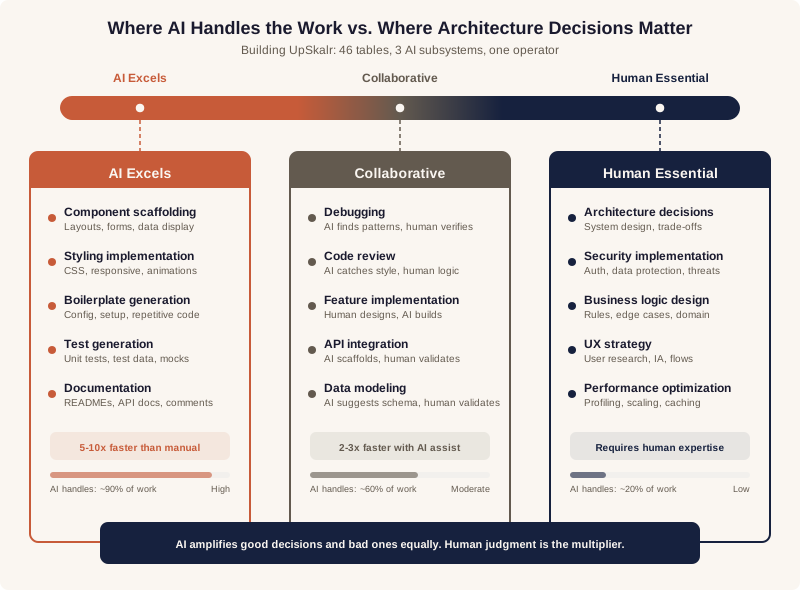
The question I wanted to answer: can an experienced architect, working with AI development tools, build a production SaaS platform that would traditionally require a dedicated engineering team? Not a prototype. Not a minimum viable product. A platform with real users, real payments, enterprise-grade security, and AI that adapts to individual user behavior.
UpSkalr is a behavioral analytics and performance improvement platform. Users track their daily performance, log decisions and mental states, and receive AI-powered coaching based on their individual patterns and goals. The domain requires sophisticated data modeling (tracking hundreds of data points per user per day), real-time AI that understands each user’s history and context, and the kind of UX sensitivity that comes from understanding how people actually change behavior.
I chose this domain specifically because it’s hard. A simple CRUD app wouldn’t prove the point. I needed a platform that required: multiple AI subsystems sharing context through a unified data layer, complex database architecture with row-level security, real-time streaming, subscription billing, and compliance requirements. If I could build that alone with AI tools, the same approach would work for any mid-market company’s internal tools or customer-facing products.
The Approach
Three AI Subsystems, One Unified Architecture
Decision-makers: the business results are in the next section. This section is the architecture detail your technical team will want to evaluate.
The specific domain matters less than the pattern: three distinct AI subsystems that share context through a unified data layer, each handling a different interaction pattern. The same architecture applies to customer success platforms, onboarding systems, or any internal tool where AI needs to understand individual user history to be useful.
Avyras Live: Context-Aware Real-Time Coaching
A real-time streaming AI coach that adapts its responses based on the user’s current state, recent performance patterns, and documented goals. This isn’t a chatbot wrapper: the system reads from 46 tables of user context before generating each response. If a user logged a high-stress day, the AI adjusts its coaching approach. If they’ve been violating their own rules consistently, the AI addresses that pattern specifically.
The coaching system includes a two-tier safety detection framework for crisis scenarios, conversation pacing controls to prevent endless question loops, and outcome tracking that records whether the conversation actually helped. The streaming architecture uses server-sent events through Deno edge functions, with rate limiting and GDPR consent recording.
Avyras Scribe: Voice-to-Structured-Data Pipeline
Users speak naturally into a microphone, and the system converts that unstructured voice input into structured database records. Real-time transcription via Deepgram Nova-2 WebSocket, then AI-powered field mapping that identifies which parts of the transcript correspond to which database fields. Mental state inference analyzes tone and language to suggest stress levels and confidence scores.
This solves a real UX problem: people will talk about their day for 5 minutes but won’t fill out a 20-field form. Voice-to-structured-data captures the same information with dramatically lower friction.
Avyras Intel: Scheduled Intelligence Engine
Background analysis that surfaces patterns the user wouldn’t notice manually. Daily, weekly, and monthly AI-generated insights that pull from the user’s full history: recent performance, journal entries, documented rules and violations, cognitive bias patterns. Three edge functions run on scheduled crons, each generating time-horizon-appropriate analysis.
Database Architecture
46 PostgreSQL tables organized across logical domains: performance data, psychology metrics, AI interactions, community features, and subscription management. 100+ row-level security policies ensure every user only sees their own data, with authorization enforced at the database level, not in application code. 53 custom SQL functions handle business logic in the database. 21 triggers auto-update timestamps, sync data, and cascade calculations.
Business Infrastructure
Stripe subscription management with tiered pricing and add-on products. 18 serverless edge functions handling AI operations, scheduled jobs, and external integrations. GDPR compliance with consent recording and data deletion endpoints. A full admin dashboard for user management, AI analytics, and content moderation.
Scale
20,500+ lines of backend TypeScript across 18 edge functions. Statistical modeling engine for pattern analysis and scenario planning. Custom algorithms optimized for domain-specific behavioral data.
The Results
Production-Grade, Not Prototype-Grade
Live users on the platform. Three AI subsystems operating in production with real user data. Enterprise-grade database architecture handling hundreds of data points per user per day. Stripe subscription management processing real payments.
The platform covers every capability a mid-market company needs in a custom application: user authentication, subscription billing, real-time AI, voice interfaces, scheduled background processing, row-level security, GDPR compliance, admin oversight, and analytics.
UpSkalr is one of several production applications I’ve built with AI-assisted development. This consulting website (49+ pages, interactive assessment tools, ranking for competitive keywords) and PromptAssay (a prompt engineering workbench detailed in a separate case study) were built with the same approach. Each proves a different aspect of what’s possible.
Why This Matters
What Your Team Could Build
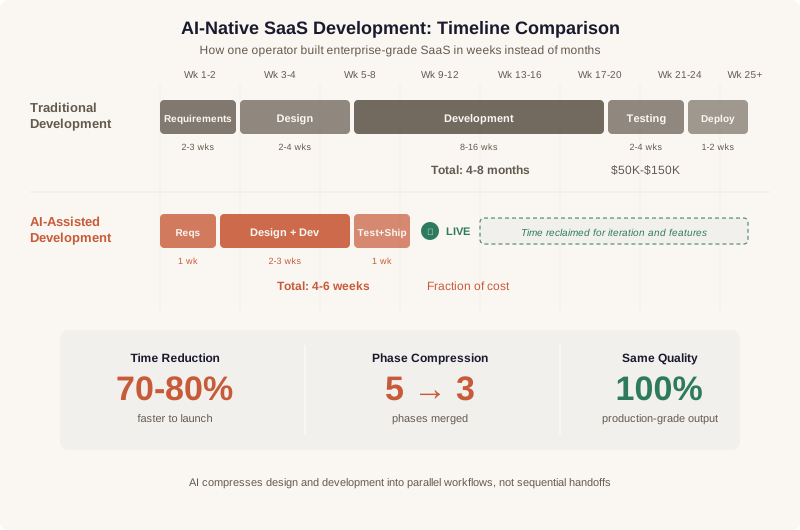
If a solo operator can build enterprise-grade SaaS with AI development tools, what can your existing engineering team do? The build-vs-buy calculation has changed. Custom internal tools, customer portals, and process applications that used to cost $50K–$150K and take 6 months can now be built in weeks at a fraction of the cost.
Context-aware AI isn’t just for consumer applications. The same patterns that power UpSkalr’s coaching system, reading from a rich data model, adapting responses to individual context, tracking whether the AI actually helped, apply directly to internal tools. Customer success platforms that adapt to each account’s history. Onboarding systems that adjust based on the employee’s role and progress. Decision-support tools that pull from your company’s specific data.
Key Takeaways
Ready to Build What You Couldn’t Justify Before?
I help mid-market companies use AI-assisted development to build custom tools, portals, and applications at a fraction of traditional cost and timeline. The same architecture patterns that built a 46-table SaaS platform apply to your internal tools. Book a strategy call to discuss what you need built.