
Key Takeaways
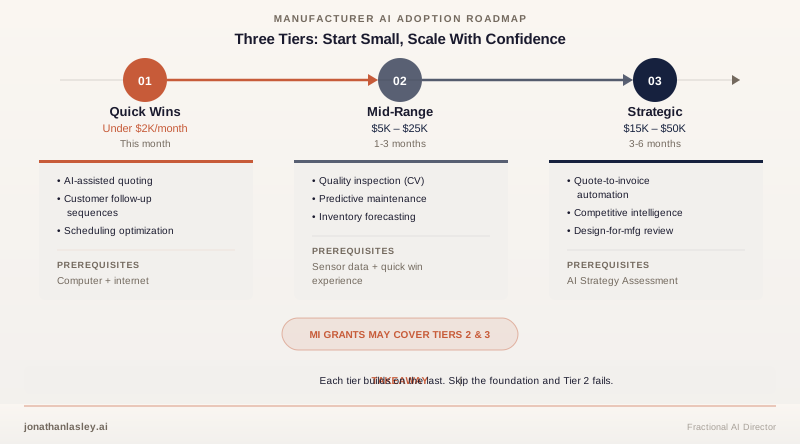
- Start in the office, not on the shop floor. AI-assisted quoting, automated customer follow-ups, and scheduling optimization deliver ROI in days for under $2,000.
- The #1 barrier to manufacturing AI adoption is lack of expertise (45%), not cost. A single focused quick win builds competence without needing a data scientist.
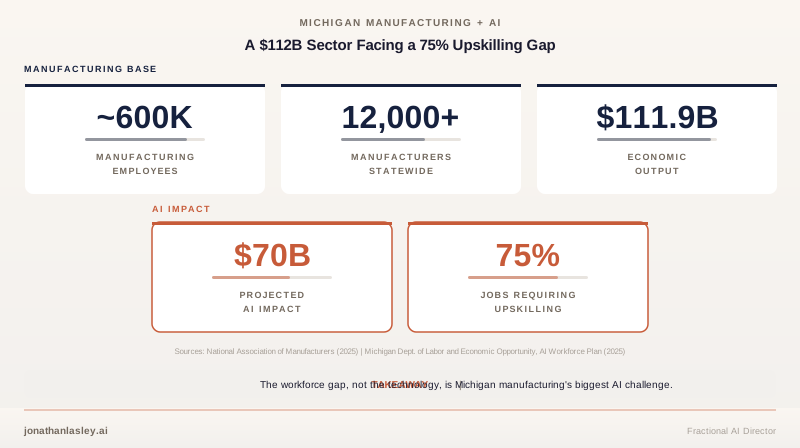
- Michigan's AI Workforce Plan projects $70 billion in economic impact and 130,000 new jobs, with 75% of manufacturing roles requiring upskilling.
- Active state programs can offset costs: Going PRO Talent Fund ($55M+ pool), free MMTC technology assessments, and MI Hub connecting manufacturers to $17M in grants.
- Nearly 300 manufacturers in the Flint and Genesee region are positioned to benefit. The infrastructure exists; the gap is awareness and action.
Start in the Office, Not on the Shop Floor
Every "AI for manufacturing" article leads with predictive maintenance and computer vision. Those are real, proven applications. But they're complex, expensive, and require clean sensor data most small manufacturers don't have organized yet.
The pattern I see across industries: the highest-ROI starting point for companies with 10–200 employees is almost always administrative work quietly eating margins. For manufacturers, that's quoting that takes 20 minutes per job, RFQ follow-ups falling through the cracks, and scheduling that lives in someone's head or a spreadsheet disconnected from the ERP. These are problems you can solve with AI tools your team already knows how to use, and they fit naturally into any lean manufacturing operation that's already focused on eliminating waste.
Grant Thornton's 2025 analysis of manufacturing AI quick wins reinforces this. Their recommendations focus on financial planning, contract management, vendor rationalization, and SOPs rather than shop-floor automation. According to Coherent Solutions (2025), 51% of manufacturers report using AI in some form, but 45% cite lack of internal expertise as the top barrier. Starting with a simple office-side project solves both problems: it delivers measurable results and builds the confidence your team needs before tackling production systems.
When I work with companies across different industries on their first AI projects, the ones that start with something their team can see and touch, like a quoting template or an automated email sequence, build momentum far faster than the ones that jump straight to sensor data and machine learning models. I see the same pattern with auto repair shops, where AI-assisted scheduling and estimate generation deliver returns long before any shop invests in diagnostic AI. The first win matters more than the first big project.
You can assess where your operation stands in three minutes with the free AI readiness assessment. It covers data readiness, team capability, and use case clarity: the three factors that determine whether your first project succeeds.

Quick Wins Under $2,000: Three Projects for This Month
These three applications don't require grants, IT staff, or vendor contracts. Any manufacturer with a computer and internet connection can deploy them this month.
1. AI-Assisted Quoting and Estimation
Use ChatGPT or Claude with structured prompts and your historical pricing data to generate estimates from job specs. A typical custom job quote takes 15–20 minutes of manual lookup, calculation, and formatting. With a well-built prompt template and your pricing history as reference material, that drops to 3–5 minutes.
The approach works like this: you feed the AI your rate card, material pricing, and a few examples of past quotes. Then when a new RFQ comes in, you paste the job specs into the prompt and get a draft estimate back in seconds. Your estimator reviews, adjusts, and sends. The AI handles the repetitive assembly; the human handles the judgment calls.
The difference between a useful AI quoting tool and a frustrating one is the quality of the prompt behind it. A generic "write me a quote" request produces generic output. A structured prompt that includes your rate card, material markup rules, margin targets, and formatting requirements produces something your estimator can actually use. Advanced prompting techniques like few-shot examples (showing the AI three of your best past quotes as templates) and chain-of-thought reasoning (asking the AI to break down material, labor, and overhead calculations step by step) turn a basic chatbot interaction into a reliable business tool. Building these prompts is part of what I do in an AI Quick Win Session: I design the prompt architecture, test it against your real job data, and train your team to maintain and refine it as your pricing changes.
- Cost: $20–$200/month for AI tool subscriptions
- Time to value: Days
- What "done" looks like: Your estimator has a prompt template that takes job specs as input and produces a formatted quote with material costs, labor hours, and margin calculations
2. Automated Customer Follow-Up Sequences
Set up AI-generated post-delivery check-ins, RFQ follow-ups, and maintenance reminders. Most manufacturers I talk to have no systematic follow-up process. Jobs ship, and the customer doesn't hear from you again until they need something.
Manufacturers who send automated 30/60/90-day follow-ups typically see 20–30% higher repeat business. The AI drafts personalized messages based on job history, order patterns, and account value. A customer who bought custom brackets six months ago gets a check-in asking if they need another run, not a generic marketing email.
- Cost: $50–$150/month (existing CRM plus AI integration)
- Time to value: 1–2 weeks
- What "done" looks like: Every completed job triggers a sequence of delivery confirmation, 30-day satisfaction check, 60-day reorder prompt, and 90-day relationship touchpoint
3. Scheduling and Capacity Planning
AI analyzes job history, machine availability, and lead times to flag scheduling conflicts and spot idle capacity. For shops tracking OEE (Overall Equipment Effectiveness), this is where the data starts paying off. It doesn't replace your scheduler. It gives them a tool that processes information faster than a whiteboard and spreadsheet can.
- Cost: $100–$500/month
- Time to value: 2–4 weeks
- What "done" looks like: A scheduling view showing current utilization, flagging conflicts 48 hours out, and suggesting resequencing based on due dates and machine constraints
Total monthly investment for all three: $170–$850. That's the cost of a few hours of shop labor for improvements that compound every week. For hands-on help getting started, an AI Quick Win Session ($500–$750) walks you through setup in a single afternoon.
When You're Ready for More: Mid-Range and Strategic Projects
After your team has built confidence with quick wins, these projects deliver bigger returns but require more planning and, in some cases, data infrastructure you may need to build first.
Mid-Range Projects ($5,000–$25,000)
Quality inspection automation. Computer vision can inspect parts at full production speed. Industry data shows AI-powered visual inspection achieves 95–99% accuracy, catching defects human inspectors miss during long shifts. For a manufacturer running two shifts, that's a direct impact on scrap rates and customer returns.
Predictive maintenance. This is the application everyone mentions first, but it belongs at Tier 2 because it requires sensor data from your equipment. The U.S. Department of Energy reports that predictive maintenance reduces equipment breakdowns by 70–75% and cuts downtime by 35–45%. Those numbers are real, but getting there means instrumenting machines, collecting baseline data, and training models on your specific equipment. That's a $5,000–$25,000 project, not a weekend experiment.
Inventory demand forecasting. AI analyzes seasonal patterns, order history, and supply chain signals to optimize stock levels. Overstock and stockouts are margin killers, and pattern recognition is exactly what AI does well.
Strategic Investments ($15,000–$50,000)
For manufacturers ready for full-scale transformation, the next tier includes end-to-end workflow automation from quote to invoice (often integrating with your existing ERP or MES), competitive intelligence systems tracking material costs and competitor pricing, and AI-assisted design-for-manufacturability review. AI implementation in manufacturing at this level requires proper scoping and consulting expertise to get right.
Mid-range and strategic projects are where a structured AI Strategy Assessment ($7,500–$15,000) pays for itself: proper scoping prevents the common failure modes that waste budgets. The methodology I use follows the same four-phase approach from The Mid-Market AI Playbook: assess, quick wins, strategic builds, optimize. That framework is industry-agnostic because the failure modes are industry-agnostic. Whether you're a $30M machine shop quoting custom CNC work or a $150M professional services firm, the companies that skip the assessment phase and jump straight to a $50,000 build are the ones that end up calling me to fix what went wrong. AI for machine shops follows the same progression: start with quoting and scheduling quick wins, prove the value, then invest in vision systems and predictive maintenance.
Michigan Funding Programs for Manufacturing AI
Michigan manufacturers have access to several active programs that can offset the cost of mid-range and strategic AI projects. For a complete guide to national programs including federal grants and R&D tax credits, see the national AI funding guide. The funding landscape changes frequently, so I've included current status and contact information for each.
Going PRO Talent Fund
The state's largest workforce training program draws from a $55M+ annual pool. AI training is explicitly eligible as long as it covers specific technical skills (not generic AI literacy). FY2026 Cycle 1 funded 449 businesses. Cycle 2 is expected spring 2026. My AI training workshops are structured to meet Going PRO's skills-based requirements, so your team gets trained and the fund offsets the cost.
MI Hub for Manufacturers
Launched June 2025, MI Hub connects manufacturers to $17M in grants and loans across multiple programs. If you're not sure which programs you qualify for, start here.
MMTC Free Industry 4.0 Technology Assessment
The Michigan Manufacturing Technology Center offers free technology assessments covering AI, robotics, cybersecurity, and IoT readiness. A zero-cost way to get an expert evaluation of where your operation stands before investing.
One caveat: MMTC is part of the national Manufacturing Extension Partnership network, and federal MEP funding is uncertain. The current administration has proposed eliminating the program, though Congress allocated $175M for FY2026 and directed continued operations. MMTC services are available now, but I'd recommend scheduling the free assessment sooner rather than later. These programs may not exist in this form indefinitely.
MEDC Industry 4.0 Grant (Funding Exhausted)
Michigan invested $6M through the MEDC Industry 4.0 program, reimbursing 50% of qualifying technology costs up to $25,000 per company. The program funded 185 manufacturers across six regional partners before the funding was fully allocated. According to the FY2024 MSF Annual Report, 113 grants totaling $2.5M were distributed in FY2024 alone. The program is no longer accepting applications, and no new funding rounds have been announced.
Why mention a closed program? Because similar programs in other states (Iowa's Manufacturing 4.0 at $75K, Maryland's at $500K) are actively funded, which suggests Michigan could fund additional rounds. Contact your regional administrator (Automation Alley, MMTC, or GLBMA for the Genesee/Saginaw region) to ask about future availability.
The funding landscape changes constantly. That's exactly the kind of thing I track. If you're not sure what's still available, book a call and I'll walk you through the current options.
The Bigger Picture
Michigan has nearly 600,000 manufacturing employees across 12,000+ manufacturers, generating $111.9 billion in economic output (NAM, 2022). That spans everything from Detroit's automotive supply chain and Grand Rapids' furniture and advanced manufacturing cluster to specialty machine shops across the state. The state's AI Workforce Plan projects $70 billion in economic impact, with 75% of manufacturing jobs requiring some form of upskilling. Nearly 300 manufacturers in the Flint and Genesee region alone employ more than 13,000 people. AI manufacturing in Michigan is past the hype cycle; the question isn't whether to adopt, it's where to start.
I'm based in Flushing, right in the middle of this manufacturing corridor. As a Fractional AI Director, the conversations I have with local shop owners confirm what the data shows: interest in AI is high, but most don't know where to start. For a broader look at Michigan's AI ecosystem, including the Stargate campus, Switch data center, and the state workforce plan, see AI Consulting in Michigan.
Download the Michigan Manufacturer's AI Quick-Start Guide
A two-page PDF with the three quick wins, prompt architecture framework, tool recommendations, cost ranges, Michigan funding programs, and a first-week action checklist. Print it for your next operations meeting.
Frequently Asked Questions
How much does AI cost for a small manufacturer?
Quick-win AI projects (quoting, customer follow-ups, scheduling) cost $170–$850 per month with no upfront investment. Mid-range projects like predictive maintenance or quality inspection run $5,000–$25,000. Strategic implementations range from $15,000–$50,000. Michigan funding programs like Going PRO can offset training costs, and MI Hub connects manufacturers to $17M in grants and loans across multiple programs. An AI Quick Win Session ($500–$750) is the fastest way to get your first project running without figuring it out alone.
What are the best AI quick wins for manufacturers?
Three projects deliver the fastest return: AI-assisted quoting (cuts estimate time from 15–20 minutes to 3–5), automated customer follow-up sequences (drives 20–30% higher repeat business), and scheduling optimization (reduces conflicts and idle time). All three deploy for under $2,000/month total with no IT department required.
Do small manufacturers need an IT department to use AI?
No. The quick wins in this article use tools like ChatGPT, Claude, and basic CRM integrations that any computer-literate employee can operate. The #1 barrier is lack of expertise (45%), not infrastructure. Starting with a focused office-side project builds AI competence without needing a data scientist or IT department.
What grants are available for Michigan manufacturers adopting AI?
Three active programs and one worth watching: Going PRO Talent Fund ($55M+ annual pool for AI training), MI Hub for Manufacturers (portal to $17M in grants and loans), and MMTC's free Industry 4.0 Technology Assessment. The MEDC I4.0 grant (up to $25,000 at 50% reimbursement) funded 185 manufacturers before its funding was fully allocated, but future rounds are possible. Going PRO and MI Hub are the most accessible starting points today. If you're not sure which programs apply to your shop, book a free 30-minute strategy call and I'll walk you through the options.
Should manufacturers start AI on the shop floor or in the office?
Start in the office. Predictive maintenance and computer vision require sensor data, clean datasets, and $5,000–$25,000+ investment. Office-side AI (quoting, follow-ups, scheduling) delivers ROI in days for under $2,000 and builds the organizational confidence you need before tackling shop-floor systems. For a structured approach to measuring which investments are worth it, model the ROI before committing to Tier 2 projects.
Ready to Find Your First Manufacturing AI Quick Win?
The gap between Michigan manufacturers who benefit from AI and those who don't comes down to one thing: knowing where to start.
Take the free AI readiness assessment to see where your operation stands in three minutes. If you want hands-on help, an AI Quick Win Session ($500–$750) deploys a working tool in a single afternoon. For manufacturers ready to scope mid-range or strategic projects, an AI Strategy Assessment ($7,500–$15,000) delivers a prioritized roadmap with a working prototype.
