
Key Takeaways
- AI ROI has four dimensions, not one: revenue impact, cost reduction, time savings, and risk mitigation. Most companies only calculate cost savings and miss the majority of the value.
- The cost of inaction is a real number. According to PwC's CEO Survey (2025), 40% of CEOs believe their companies won't survive the next decade without AI transformation. Calculate what you lose by waiting, not just what you gain by investing.
- Early AI adopters report $3.70 in value per dollar invested (McKinsey, 2025), but only when AI connects to specific business problems. Unfocused experimentation produces zero measurable return.
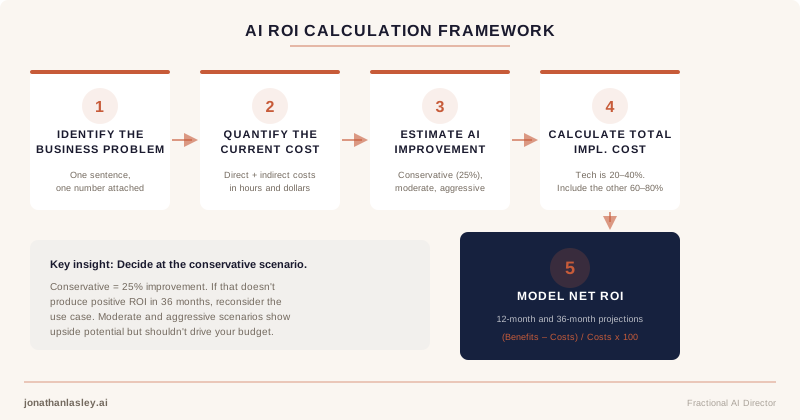
- You can model AI ROI before spending a dollar using a five-step framework: identify the business problem, quantify the current cost, estimate AI-driven improvement, calculate implementation costs, and model net return.
- A $7,500–$15,000 AI Strategy Assessment delivers ROI projections for your top opportunities with financial models your CFO can evaluate, before you commit to a larger investment.
Why Most AI ROI Calculations Get It Wrong
According to CIO research (2025), 49% of organizations struggle to estimate and demonstrate the value of their AI projects. Nearly half of every company investing in AI can't tell you whether it's working.
AI delivers real value. Most companies just measure it wrong, or don't measure it at all.
I've watched companies buy eight, ten, sometimes fifteen AI tools with no plan connecting them. Each one solved a narrow problem in a vendor demo. None of them talk to each other. The result is a fragmented AI ecosystem where different departments run different tools with no shared architecture and no way to measure cumulative impact. The company could be developing targeted solutions internally using next-generation development platforms at a fraction of the cost, with far better integration. Instead, they're accumulating subscriptions and technical debt.
That pattern, which I've written about as "Buying Without Architecture", is a procurement habit masquerading as a strategy. And it makes ROI impossible to calculate because there was never a baseline to measure against.
The deeper mistake is narrowing the ROI calculation to a single dimension: cost savings. When I ask mid-market CEOs how they'd measure AI success, the most common answer is some version of "headcount reduction" or "labor hours saved." That captures maybe 30–40% of the actual value. Revenue impact, time savings that compound into new capabilities, and risk reduction all get ignored because they're harder to quantify upfront.
They're harder, but not impossible. And quantifying them before you invest is exactly how you avoid joining the 95% of AI pilots that fail to deliver measurable results.
The Four Dimensions of AI ROI
Every AI initiative I evaluate gets scored across four dimensions. Skipping any of them means undervaluing the investment, which leads to bad decisions about where to spend and when to start.
Revenue Impact
AI doesn't just cut costs. It creates revenue. Faster proposals mean more deals submitted per quarter. Better lead scoring means sales teams focus on prospects that actually convert. AI-powered competitive intelligence means you spot market shifts before your competitors do.
For a professional services firm with a 90-day sales cycle, compressing that cycle by even 15% through AI-assisted proposal generation and client research means one to two additional closed deals per quarter. At average deal sizes of $50,000–$200,000, that's real top-line growth from a single use case.
Cost Reduction
This is the dimension everyone calculates, and it's the most straightforward. Labor hours saved, error rates reduced, vendor tools consolidated, rework eliminated. If your team spends 40 hours per week on competitive analysis and AI compresses that to 4, you've freed up 36 hours of expensive human capacity. I've built systems that delivered exactly that ratio for AI consulting clients.
For a concrete example, the AI content automation pipeline case study shows how a single workflow cut article production from 8 hours to 45 minutes, a 90% reduction that freed up 30+ hours per week. Cost reduction is easy to model but dangerous to overweight. If it's the only dimension in your ROI calculation, you'll reject high-value AI initiatives that create revenue or reduce risk but don't directly eliminate labor hours.
Time Savings
This is the dimension mid-market companies underestimate most. The first-order effect is obvious: processes run faster, decisions happen sooner, research that took days takes hours. But the second-order effects are where the real value compounds.
When AI removes repetitive tasks, employees don't just save hours. They redirect that time toward work AI can't do: building client relationships, developing new service offerings, solving complex strategic problems. Morale goes up because people work on meaningful challenges instead of manual data entry. Skill development accelerates because employees have bandwidth to learn and cross-train. Revenue follows because those freed-up hours go toward business development and competitive positioning.
A team that saves 20 hours per week on manual reporting doesn't just save $X in labor cost. They now have 20 hours per week to pursue the opportunities that grow the business. Cost reduction is linear. Time savings that free people for higher-value work create compounding returns.
Risk Mitigation
AI reduces risk in ways that don't show up on a P&L statement until something goes wrong. Compliance automation catches errors that would have become regulatory fines. Quality assurance systems flag defects before they reach customers. Competitive intelligence monitoring alerts you when a competitor launches a capability that affects your pipeline.
The ROI of risk mitigation is the cost of the bad outcome multiplied by the probability that AI prevents it. A single compliance violation avoided can dwarf the entire cost of an AI initiative. A single competitive move detected six months early can protect millions in revenue.

How to Calculate AI ROI Before You Invest
This is the framework I use during every AI Strategy Assessment. If you haven't assessed your overall readiness yet, start with the AI Readiness Assessment Checklist. If you're evaluating whether to bring in outside help, this comparison of AI consulting models and costs covers the options at the mid-market scale. ROI planning is one component of a complete AI roadmap framework that sequences assessment, quick wins, and strategic builds across 12 months. The ROI framework below works for any AI use case, at any budget level, and you can run through it before spending a dollar on technology.
Step 1: Identify the Business Problem
Start with the problem, not the tool. "We want to use AI" isn't a business problem. "Our proposal team spends 30 hours per week on first drafts that could be templated" is a business problem. "We lose 12% of deals because our response time is slower than competitors" is a business problem.
If you can't state the problem in one sentence with a number attached, you're not ready to calculate ROI. You're still in discovery mode, and that's fine. But don't buy anything yet.
Step 2: Quantify the Current Cost
Measure what the problem costs today. Include direct costs (labor hours, error rates, revenue lost) and indirect costs (opportunity cost of delayed decisions, employee frustration, competitive disadvantage). Be specific. "It's expensive" doesn't count. "$14,400 per month in analyst time on manual competitive reports" counts.
Step 3: Estimate AI-Driven Improvement
Use three scenarios: conservative (25% improvement), moderate (50% improvement), and aggressive (75% improvement). Conservative scenarios are where I recommend making decisions. Moderate and aggressive scenarios show upside potential but shouldn't drive your budget.
For the proposal team example: if 30 hours per week currently costs $3,750 (at a blended rate of $125/hour), a conservative 25% reduction saves $937/week, or roughly $48,750 per year. A moderate 50% reduction saves $97,500. Those numbers don't include the revenue impact of faster proposals or the time-savings compound effect.
Step 4: Calculate Total Implementation Cost
This is where most ROI models fall short. Technology licensing is typically 20–40% of the real cost. The rest is data preparation, integration, training, and change management. For a mid-market company, a realistic implementation budget looks like this:
| Cost Category | Typical Range | % of Total |
|---|---|---|
| AI Strategy Assessment | $7,500–$15,000 | 10–15% |
| Technology/licensing | $5,000–$25,000/year | 15–25% |
| Integration and development | $15,000–$50,000 | 25–35% |
| Training and change management | $5,000–$15,000 | 10–20% |
| Ongoing optimization | $5,000–$10,000/month | 15–25% |
Untrained employees are 6x more likely to say AI makes them less productive. Cutting the training budget to save money in the short term is the most expensive decision you can make. Several federal and state funding programs can offset these costs, particularly for training, R&D expenses, and initial assessments.
Step 5: Model Net ROI
Subtract total implementation cost from projected benefits across a 12-month and 36-month horizon. The formula is straightforward:
ROI = (Total Benefits – Total Costs) / Total Costs x 100
For the proposal team example at the conservative scenario: $48,750 in annual time savings (before revenue impact and risk reduction) against roughly $40,000–$70,000 in first-year implementation costs. The 12-month ROI might be modest or break-even. The 36-month ROI, as adoption deepens and the system improves, is where the investment pays off meaningfully.
McKinsey's data backs this up: early adopters report $3.70 in value for every dollar invested, with top performers reaching $10.30. But those returns show up over time, not overnight.
The Cost of Inaction: What You Lose by Waiting
Most AI ROI analysis asks "is AI worth investing in?" That's the wrong framing. The better question: "what does it cost to not invest?"
Doing nothing carries real costs that compound every quarter you wait.
According to PwC's CEO Survey (2025), 40% of CEOs believe their companies won't survive the next decade without charting a new path amid AI-driven change. That's not consultants selling fear. That's CEOs looking at their own competitive landscape and reaching the same conclusion.
The cost of inaction for a mid-market company shows up in four places:
Competitive gap. Your competitors are already moving. The RSM Middle Market AI Survey (2025) found that 91% of middle market companies have adopted generative AI. If you're in the 9% that hasn't, you're falling behind. If you're in the 66% that adopted but haven't integrated AI into core operations, you're spending money without getting results, which is worse. The Mid-Market AI Playbook outlines the four-phase sequence that turns adoption into integration.
Rising labor costs. Every hour an employee spends on a task AI could handle is an hour they're not spending on work that requires human judgment. As wages rise, that gap widens. The operational costs you're paying today will be higher next year.
Talent attrition. Strong employees want to work with modern tools. Companies that don't invest in AI increasingly lose their best people to companies that do. The replacement cost of a skilled employee runs 50–200% of their annual salary.
Declining win rates. When your competitor responds to RFPs in 48 hours because AI drafted the first version, and you respond in two weeks because your team writes from scratch, you lose deals you would have won. That revenue loss compounds quarterly.
For a concrete example from outside my client work: a mid-market automotive parts manufacturer in Michigan cut production planning time from 8–10 hours to 3.2 hours per day, a 60% reduction. Within six months, their AI system uncovered $2.3 million in cost-saving opportunities and boosted on-time delivery rates from 78% to 94%. The cost of inaction for that company was $2.3 million in savings they wouldn't have found, plus every late delivery that cost them customer trust.

The Common Mistake: Measuring Against the Wrong Baseline
When mid-market leaders evaluate AI, I see the same mistake over and over: they compare the cost of AI to the cost of a full-time AI hire.
"A full-time AI director costs $250,000–$400,000 per year. A Fractional AI Director costs $5,000–$10,000 per month. So the fractional option saves us $190,000+ per year."
That math is correct but misleading. It answers the wrong question.
The right baseline isn't "how much does AI leadership cost?" It's "what's the difference between our current state without AI and our future state with AI?" That gap, measured across all four ROI dimensions, is the real number that matters.
A fractional engagement at $60,000–$120,000 per year delivers the same strategic AI leadership as a full-time executive at one-fifth the cost. (For the full cost breakdown across all three leadership models, see the fractional vs. full-time vs. consulting firm comparison.) But the value of that engagement isn't the salary savings. It's the revenue generated, costs reduced, time saved, and risks mitigated by having someone who can walk into a boardroom and speak ROI, then walk into a dev environment and ship code.
When I run an AI Strategy Assessment, the deliverable includes ROI projections for the top three opportunities with conservative, moderate, and aggressive scenarios. Financial models your CFO can evaluate. Not a slide deck with abstract potential, but specific dollar figures tied to specific use cases in your business. That's the pre-investment ROI calculation most companies skip, and it's the step that separates the 5% that succeed from the 95% that don't.
Frequently Asked Questions
How do you calculate AI ROI before deploying any technology?
Use a five-step framework: identify the specific business problem, quantify what that problem costs today (in hours, dollars, and error rates), estimate conservative AI-driven improvement (25–50% is a safe starting range), calculate total implementation costs including hidden expenses like data prep and training, then model net ROI across 12 and 36 months. An AI Strategy Assessment runs this analysis for your top opportunities in 1–2 weeks, delivering projections with real numbers.
What is the average ROI on AI investments for mid-market companies?
McKinsey's 2025 research found that early AI adopters report $3.70 in value for every dollar invested, with top performers achieving $10.30 per dollar. The critical variable isn't company size. It's whether AI connects to a specific business problem with clear metrics. Mid-market companies that start with a focused assessment and target their highest-ROI use case first typically see positive returns within 90 days through quick wins.
How long does it take to see ROI from an AI investment?
Employee productivity impact is near-immediate. When people get properly trained on AI tools, especially advanced prompt engineering, the effect on their daily output shows up within days. I've seen teams go from skeptical to genuinely excited within a single week of hands-on training. AI training workshops are where that shift happens fastest. Business and financial ROI takes longer: 60–90 days for quick wins like workflow automation and report generation, 6–12 months for strategic impact like revenue growth and competitive positioning. Track both timelines. Companies that only measure financial metrics in the first 30 days conclude "AI isn't working" while their employees are already 2–3x more productive.
What costs should I include when calculating AI ROI?
Technology licensing is only 20–40% of the real cost. Include data preparation and cleanup, system integration, team training and change management, ongoing optimization, and the time your internal team spends supporting the rollout. Training is the expense companies cut first and regret most: untrained workers are 6x more likely to report that AI makes them less productive. Budget 60–80% of your total AI investment for everything that isn't the technology itself.
How do I measure the cost of NOT investing in AI?
The cost of inaction has four components: competitive gap (competitors using AI are winning deals you're losing), rising labor costs (every manual process gets more expensive each year), talent attrition (strong employees leave for companies with modern tools), and declining win rates (AI-enabled competitors respond faster and deliver more). Quantify each by asking: "What would this cost us over the next 12 months if nothing changes?" Then compare that number to the cost of an AI Strategy Assessment at $7,500–$15,000. For most mid-market companies, the cost of one quarter of inaction exceeds the entire assessment investment.
Ready to Model Your AI ROI?
The companies that get value from AI share one trait: discipline. They calculate ROI before investing, target the highest-impact use case first, and measure across all four dimensions.
Take the free AI readiness assessment to get a personalized snapshot of where your company stands across strategy, adoption, data readiness, and use case clarity. Or book a free 30-minute AI strategy call to walk through the ROI framework with your specific numbers.
