
Key Takeaways
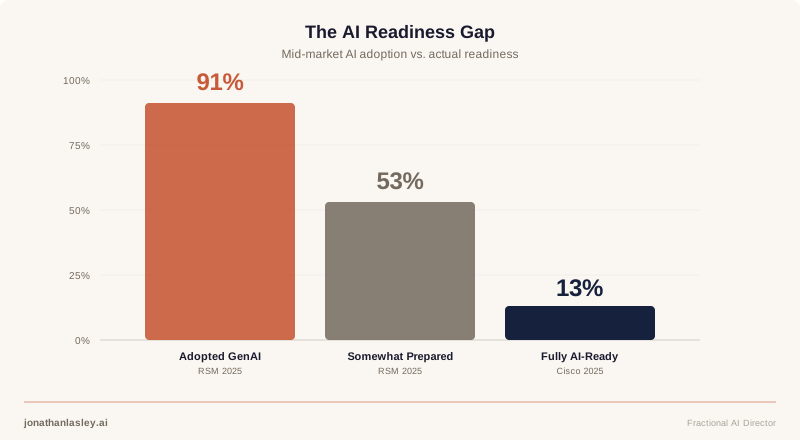
- Only 13% of companies are fully AI-ready (Cisco 2025), yet 91% of mid-market companies have adopted generative AI (RSM 2025). That gap between adoption and readiness is where investments fail.
- Executive sponsorship is the single biggest readiness predictor. Data and infrastructure gaps are fixable in weeks. Leadership gaps aren't.
- You don't need clean data, you need accessible data. 63% of organizations lack proper data management for AI (Gartner 2025), but the real barrier is access, not quality.
- Each question includes a "ready" answer, a "not ready" answer, and a specific next step to close the gap.
- Take the free AI readiness assessment for a personalized scorecard in 3 minutes.
- Already evaluating a specific AI initiative? Take the AI Project Risk Assessment to score it against the five failure modes that kill 95% of projects.
Why Readiness Matters More Than Enthusiasm
According to the RSM Middle Market AI Survey (2025), 91% of mid-market companies have adopted generative AI, but only 53% say they were "somewhat prepared." Meanwhile, MIT's 2025 research found that 95% of enterprise AI pilots don't deliver measurable return. Gartner predicted that 30% of generative AI projects would be abandoned after proof of concept by end of 2025.
The cost of investing before you're ready isn't always a dramatic project failure. More often, it's the quiet accumulation of AI tool subscriptions, disconnected pilots, and time spent on discovery that never connects to business value. I see this pattern regularly: companies spending $5K–$15K per month across a growing stack of AI tools that nobody evaluated against a strategic plan. Over 12–18 months, that's $60K–$270K spent "experimenting with AI" with nothing to show for it. The five failure modes covered in Why 95% of AI Projects Fail map directly to readiness gaps you can identify before spending a dollar.
These 15 questions won't take long to answer. But they'll tell you whether your company belongs in the 13% that's ready to invest, or whether you need to close specific gaps first.
Dimension 1: Strategic Alignment (Questions 1–3)
Most AI initiatives die here. Not from bad technology, but from vague intent.
Question 1: Does your leadership team agree on what specific business problems AI should solve?
"Ready" means leadership can name 2–3 concrete problems with dollar values attached: "We're losing $200K/year in manual proposal errors" or "Customer onboarding takes 3 weeks and should take 3 days." "Not ready" means the conversation stalls at "We want to use AI to improve productivity." Employee productivity gains are real and worth pursuing, but they're table stakes. The companies that get the most from AI move past "make our people faster with ChatGPT" and identify specific business pain points: automating a broken quoting process, building a competitive intelligence system, or restructuring how customer data flows across departments.
Question 2: Have you identified a specific process where AI could save measurable time or money?
A specificity test. "Ready" means you can point to a process, name the current cost, and estimate what AI could save. "Not ready" means AI is still an abstract interest. If you aren't sure where to start, an AI Strategy Assessment identifies the 2–3 highest-ROI use cases in your business within 1–2 weeks. For a deeper look at modeling returns before you invest, see How to Measure AI ROI Before You Invest a Dollar.
Question 3: Is there an executive sponsor who will own the AI initiative?
The single most important question on this list. Without an executive sponsor who has authority and accountability, AI initiatives drift into disconnected experiments. The sponsor doesn't need to be technical. They need to own the outcome, remove organizational blockers, and ensure AI work connects to business goals. When a company brings on a Fractional AI Director, they're delegating that sponsorship and authority to someone who reports directly to top leadership. If the company isn't willing to grant that authority, the engagement won't succeed regardless of how good the technology is.
I can fix bad data in 4 weeks. I can't fix the absence of someone who owns the outcome.
Dimension 2: Data Readiness (Questions 4–6)
Data cleanliness gets all the attention, but access is the real bottleneck.
Question 4: Can you access the data needed for your top AI use case within two weeks?
The actual data readiness test. "Ready" means the data exists and someone can pull it without a multi-month project. "Not ready" means the data is either missing or locked behind governance layers that prevent anyone from using it.
I've watched this play out in both directions. One company had years of unstructured customer communications scattered across email, a CRM, and a shared drive. Messy, but accessible. An AI system started surfacing patterns within days. Another company had clean, well-organized data in a locked-down ERP, but getting AI access required a 6-month security review, three levels of approval, and a data governance committee that met quarterly. The clean data was worthless for AI because nobody could touch it. Gartner (2025) found that 63% of organizations either don't have or aren't sure they have the right data management practices for AI. Governance that prevents AI from accessing data is more damaging than messy data that AI can access.
Question 5: Is your customer and operational data in one system or scattered across multiple tools?
Scattered data isn't a dealbreaker, it's a scoping factor. "Ready" means you know where the data lives, even if it's in multiple systems. "Not ready" means nobody has a clear picture of what's where.
Question 6: Do you have a data inventory, or would creating one be a project in itself?
If creating a data inventory sounds like a 3-month initiative, that's useful information, not a barrier. Most mid-market AI projects don't need a full data inventory. They need to know where the data for one specific use case lives. Start there.
Dimension 3: Governance and Risk (Questions 7–8)
Mid-market governance doesn't need to be complex. A two-page AI use policy is enough to start.
Question 7: Do you have any policy governing how employees use AI tools today?
"Ready" means you have at minimum a written guideline covering which AI tools are approved, what data can and can't be shared with them, and who to ask when uncertain. "Not ready" means employees are using ChatGPT and Copilot with no organizational guidance. Employees using AI is fine. Employees using AI with no guardrails on data handling is where governance gaps become breach risks. The mid-market AI governance framework covers a six-component policy structure you can implement in 20 hours, and the AI acceptable use policy template gives you the actual policy document to distribute.
Question 8: Who is responsible for AI-related decisions, and do they have the authority to act?
This connects directly to Question 3. "Ready" means there's a named individual or role with budget authority and decision rights. "Not ready" means AI decisions happen by committee, consensus, or not at all.
Dimension 4: Talent and Skills (Questions 9–11)
The RSM survey (2025) found that 39% of mid-market companies cite lack of in-house expertise as their top AI obstacle. That's a real barrier, but it's often misunderstood.
Question 9: Does anyone on your team have experience implementing AI tools or systems?
You don't need a data scientist on staff. For most mid-market AI use cases, you need AI-literate operators who can configure, prompt, and evaluate AI tools, not ML engineers who build models from scratch. If nobody on the team has this experience, AI workshops and consulting services can bridge that gap while building internal capability.
Question 10: Are employees already using AI tools informally without company guidance?
If yes, that's actually a positive signal. It means your team sees value in AI and is motivated to use it. The gap is organizational: turn informal adoption into structured, governed adoption. If the answer is no, expect a steeper change management curve.
Question 11: When you introduce new technology, do your teams typically adopt it or resist it?
Historical adoption patterns predict AI adoption patterns with surprising accuracy.
Dimension 5: Organizational Culture (Questions 12–13)
Most assessment frameworks skip this dimension. That's a mistake.
Question 12: Is leadership willing to change existing workflows based on what AI reveals?
AI that confirms what you already do is worth little. AI that reveals better approaches is worth a lot, but only if leadership acts on it. "Ready" means leadership has demonstrated willingness to change processes based on data. "Not ready" means "we've always done it this way" is the default response to suggested changes.
Question 13: Have previous technology change initiatives (CRM, ERP, cloud migration) succeeded or failed?
In 25 years of enterprise IT, I've watched the same organizational patterns repeat across every technology wave. Companies that struggled with their Salesforce rollout tend to struggle with AI for the same reasons: resistance to workflow changes, inadequate training, weak change management. AI isn't a different category of change. It follows the same patterns.
Dimension 6: Infrastructure (Questions 14–15)
Most mid-market AI use cases run on cloud-based APIs. Your infrastructure needs are simpler than you think.
Question 14: Can your current tech stack integrate with modern AI APIs?
"Ready" means your core systems have REST APIs or integration platforms (Zapier, Make, Power Automate) that can connect to AI services. "Not ready" means your critical systems are closed, on-premise, and have no API access. Most modern SaaS tools already have API integrations available. If your critical systems lack APIs, the legacy system integration guide covers five patterns for connecting AI without replacing existing infrastructure. API readiness becomes especially important when evaluating agentic AI workflows, where agents need to interact with multiple systems autonomously to execute multi-step processes.
Question 15: Do you have cloud infrastructure, or are you fully on-premise with no cloud roadmap?
Fully on-premise with no migration plan limits your AI options significantly. Most production AI services run in the cloud. If you're entirely on-premise, factor in cloud migration timeline and cost before scoping AI projects.
How to Score Your Answers
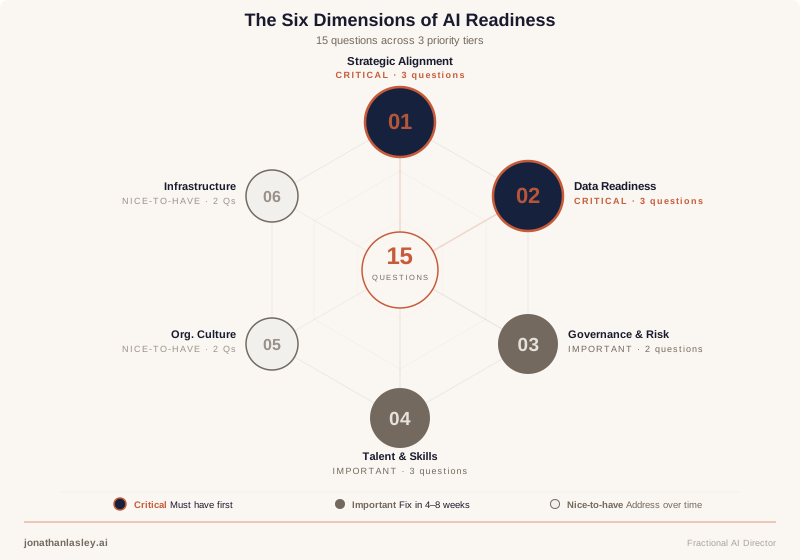
Not all 15 questions carry equal weight. Categorize your results into three tiers.
Critical (deal-breakers): Questions 1, 3, 4, and 8. These test strategic clarity, executive sponsorship, data access, and decision authority. If you answered "not ready" to two or more of these, don't invest in AI yet. Without these foundations, AI projects drift, stall, or fail outright.
Important (should fix): Questions 2, 5, 7, 9, and 12. Gaps here won't kill a project, but they'll slow it down and reduce ROI. Plan to close these within the first 4–8 weeks of an AI engagement.
Nice-to-have (can work around): Questions 6, 10, 11, 13, 14, and 15. Rarely do these block a well-scoped pilot. Address them as part of a broader AI maturity program.
Score one point for each "ready" answer, then check your tier:
- 12–15 points: You're ready. You're in the top 13% (Cisco 2025). Start with a focused AI Strategy Assessment to identify your highest-ROI use case and build toward measurable results in 90 days.
- 7–11 points: Partially ready. You have gaps, but they're closable. The typical path: address the critical gaps over 4–8 weeks, then launch a focused pilot. Not sure whether you need a fractional AI director, a full-time hire, or a consulting firm? Your readiness score helps determine the right model.
- 0–6 points: Not ready yet. Investing in AI now will waste money. Focus on closing the critical gaps first. Once you've built the foundation, the Mid-Market AI Playbook outlines the four-phase approach to your first 12 months.

Frequently Asked Questions
What is an AI readiness assessment and why does it matter?
An AI readiness assessment evaluates your company's preparedness across six dimensions: strategic alignment, data readiness, governance, talent, organizational culture, and infrastructure. It matters because 95% of enterprise AI pilots fail to deliver measurable return (MIT 2025), and most of those failures trace back to readiness gaps that were identifiable before the project started. The free 3-minute assessment on this site scores your company across these exact dimensions.
How do I know if my company is ready for AI?
Answer the 15 questions in this article and score your results. If you score 12 or above, you're ready to invest. Below 7, focus on closing critical gaps first. For a faster, personalized version, the free 3-minute AI readiness assessment on this site gives you a scored report with specific recommendations.
How long does it take to become AI-ready?
It depends on where the gaps are. Infrastructure and data access issues typically resolve in 4–8 weeks. Talent gaps can be addressed through targeted AI training in days. Strategic alignment and executive sponsorship are leadership decisions that can happen in a single meeting if the right people are in the room. Cultural readiness takes the longest: companies with a track record of resisting technology change may need 3–6 months of structured change management before AI initiatives will stick.
What's the most common readiness gap that kills AI projects?
Lack of executive sponsorship (Question 3). Without someone at the leadership level who owns AI outcomes, has budget authority, and can remove organizational blockers, AI initiatives become disconnected experiments. Data problems take weeks to fix. Tool gaps close even faster. Leadership gaps don't.
How much does a professional AI readiness assessment cost?
A self-assessment using the 15 questions in this article is free. The interactive AI readiness assessment on this site is also free and takes about 3 minutes. Both are designed to surface the right questions and give you a directional baseline, not to replace professional analysis. For an assessment with a detailed roadmap, ROI projections, and a working prototype, an AI Strategy Assessment runs $7,500–$15,000 and typically takes 1–2 weeks. Many companies recoup the investment within 90 days through quick wins identified during the process. Federal R&D tax credits and state workforce grants can also offset a significant portion of AI investment costs for qualifying companies.
Ready to Assess Your AI Readiness?
These 15 questions take about 10 minutes to work through on your own. Once you've assessed your readiness, the next step is building a phase-by-phase AI roadmap that turns those findings into a sequenced plan with budgets and timelines. For a faster, scored version, take the free AI readiness assessment to get a baseline in 3 minutes. If you're already planning a specific AI project, the AI Project Risk Assessment scores your initiative against the five failure modes that kill 95% of AI projects. Both tools are designed to surface the right questions, not replace the judgment call on what to do about the answers. A professional AI Strategy Assessment turns those questions into a prioritized roadmap with ROI projections and a working prototype. Book a free 30-minute AI strategy call to discuss what your readiness gaps actually mean for your business.
