
Key Takeaways
- 62% of enterprises sit in Stages 1–2, where financial performance falls below industry average by up to 15 percentage points (MIT CISR, 2025)
- Mid-market companies ($10M–$200M) need a maturity model built for their constraints, not frameworks designed for Fortune 500 budgets and 200-person data teams
- Each stage has specific criteria, budget benchmarks, and concrete next steps. Advancing one stage delivers measurable returns before you need to think about the next.
- 91% of high-maturity organizations have a dedicated AI leader compared to 37% of low-maturity ones (Gartner, 2024). Leadership accountability is the single biggest differentiator.
- You don't need Stage 4 to see results. Stage 2 to Stage 3 is where most companies cross the financial performance inflection point.
Free Download
AI Maturity Self-Assessment Scorecard
A printable 6-page scorecard with detailed rubrics for all five dimensions, a stage classification calculator with dimension weighting, and a team action plan with 90-day milestones. Designed for leadership teams to complete together in 30 minutes.
Why AI Maturity Models Matter for Mid-Market Companies
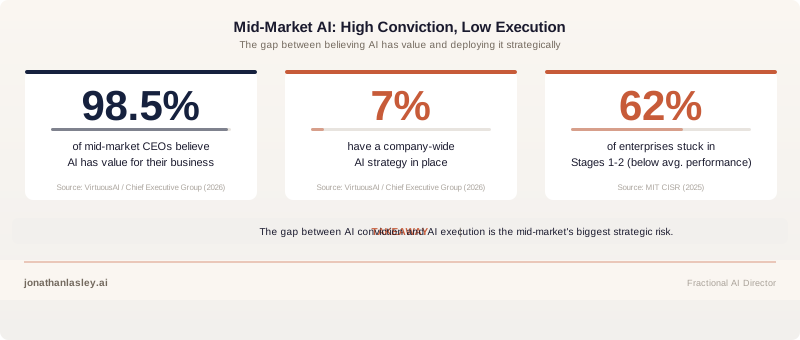
According to a VirtuousAI/Chief Executive Group survey (2026), 98.5% of mid-market CEOs believe AI has value for their business. Only 7% have a company-wide AI strategy. That gap between conviction and action is where most companies live right now, and it's costing them real ground against competitors who've closed it.
Enterprise frameworks from Gartner, MIT, and MITRE exist, but they assume you've got a Chief Data Officer, a centralized data engineering team, and an annual AI budget north of $5 million. For a $40M manufacturing company with a 12-person IT department, those frameworks create more confusion than clarity. The criteria don't map. The milestones feel unreachable. The budget benchmarks belong to a different universe.
A mid-market AI maturity model strips out the enterprise overhead and asks the questions that actually matter for companies with $10M–$200M in revenue and 50–500 employees: Do you have any AI in production? Does anyone own the AI outcomes? Can you measure what it's doing for the business?
The purpose isn't to earn a high score or impress a board with a "Stage 3" label. It's to identify the specific bottleneck preventing your next step. A CEO who knows they're Stage 2, stuck on governance, has a much clearer path forward than one who vaguely senses they're "behind on AI." Precision in diagnosis leads to precision in investment.
According to PwC's 29th Global CEO Survey (2026), 56% of CEOs report zero significant financial benefit from AI investments. Only 12% report both cost reduction and revenue gains. For mid-market leaders, that stat should be a wake-up call: investing in AI without understanding your maturity stage is how you end up in the majority that sees no return.
In my experience with enterprise IT teams, I've seen this pattern repeatedly: leaders count tools, not capabilities. We see what we want to see. A company with ChatGPT licenses, a Copilot rollout, and an AI chatbot on the website feels like it's making progress. But tools without strategy, governance, and measurement aren't maturity. They're expenses.
The Four Stages of Mid-Market AI Maturity
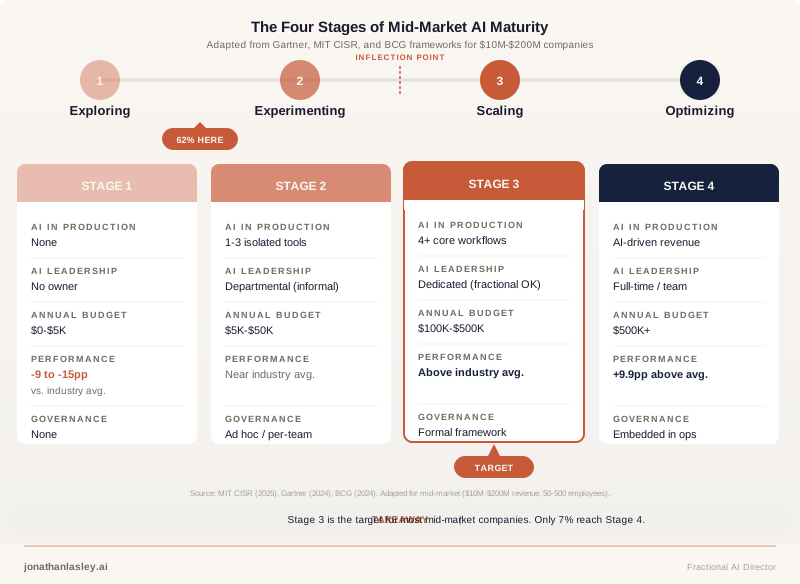
I've adapted the major enterprise frameworks (Gartner's AI Maturity Model, MIT CISR's research, BCG's AI adoption data) into four stages that reflect how mid-market companies actually operate. Each stage has clear diagnostic criteria, realistic budget expectations, and a financial performance benchmark from MIT CISR's study of 721 companies.
Stage 1: Exploring
Your company is talking about AI but hasn't deployed anything meaningful. Individual employees might use ChatGPT or Copilot for personal productivity, but there's no organizational strategy, no governance, and no measurement.
Diagnostic signals: No AI tools in production workflows. No budget line item for AI. AI discussions happen at conferences and board meetings, not in operational planning. No one owns AI outcomes.
Financial benchmark: According to MIT CISR (2022; updated 2025), companies at this stage underperform their industry average by 9–15 percentage points on revenue growth and profitability measures.
Typical budget: $0–$5,000 (individual tool subscriptions, no strategic spend)
Stage 2: Experimenting
You've run pilots or deployed point solutions, but they're isolated. A marketing team uses AI for content. Operations tested a chatbot. Finance explored forecasting. None of it connects to a broader strategy, and nobody's measuring ROI consistently.
This is where most mid-market companies sit. According to RSM's Middle Market AI Survey (2025), 91% of mid-market companies use generative AI, but only 25% have fully integrated it into their operations. The other 66% are experimenting without a plan to scale.
Diagnostic signals: 1–3 AI tools in production. No cross-functional AI strategy. ROI measurement is inconsistent or anecdotal. AI decisions happen at the department level, not the executive level. No formal governance or data standards for AI.
Financial benchmark: Stage 2 companies perform near their industry average but haven't captured the upside. The gap between Stage 2 and Stage 3 is where financial performance starts to diverge.
Typical budget: $5,000–$50,000/year (tool licenses, occasional consulting, pilot projects)
I see this stage more than any other. Companies have the proof points that AI works, but they don't have the structure to move from "interesting experiment" to "operational advantage." That's the Stage 2 trap: enough success to feel good, not enough rigor to compound it. If your AI pilots are running but nobody can tell the board exactly what they've produced in dollars, you're here. The patterns behind why AI projects stall and fail almost always trace back to this structural gap.
While you're running disconnected pilots, your Stage 3 competitors are using AI to cut proposal turnaround from 48 hours to 4, automate 60% of their claims intake, or personalize customer onboarding at scale. Every quarter at Stage 2 widens that operational gap. The MIT CISR data shows this isn't theoretical: Stage 1-2 companies underperform their industry peers by measurable percentage points, and the divergence compounds over time.
If you recognize your company in this description, find out exactly where you stand with the free 3-minute AI Readiness Assessment.
Stage 3: Scaling
AI is embedded in core business processes with executive oversight. You've moved beyond pilots into production systems that affect revenue, cost, or customer experience. There's a designated leader (even if fractional), a governance framework, and consistent ROI measurement.
Diagnostic signals: 4+ AI systems in production affecting core workflows. Designated AI leader with executive authority. Formal data governance standards. AI roadmap aligned to business strategy. Quarterly ROI reviews with board visibility.
Financial benchmark: Stage 3 companies outperform their industry average. MIT CISR data shows the financial performance inflection point occurs during the Stage 2 to Stage 3 transition.
Typical budget: $100,000–$500,000/year (fractional leadership, implementation projects, data infrastructure, training)
Stage 4: Optimizing
AI is a core competitive differentiator. Your company uses AI to create products, services, or operational capabilities that competitors can't easily replicate. Data infrastructure is mature. AI governance is embedded in business operations. You're running continuous experiments and scaling what works.
Diagnostic signals: AI-driven revenue streams or cost advantages. Proprietary data assets feeding AI systems. Continuous experimentation culture. AI integrated into strategic planning. Cross-functional data team (even if small).
Financial benchmark: According to MIT CISR, Stage 4 companies outperform their industry peers by an average of 9.9 percentage points on key financial metrics.
Typical budget: $500,000+ annually (dedicated team, infrastructure, R&D)
Only about 7% of companies reach Stage 4 according to MIT CISR's data. For most mid-market companies, Stage 3 is where the real transformation happens, and that's where the effort should focus. Reaching Stage 3 means your AI investments are generating measurable returns, your governance prevents costly mistakes, and your leadership can articulate the AI strategy to the board with confidence. Stage 4 is where AI becomes a competitive moat, and companies with board-level ambitions around valuation or market positioning should plan for it. But Stage 3 is operational, and reaching it puts you ahead of the majority of your competitors.
How to Assess Where Your Company Stands
The maturity model is only useful if you can honestly identify your current stage. That requires looking across five dimensions, not just counting how many AI tools you've bought.
Five Dimensions of AI Maturity
Strategy: Do you have a documented AI strategy tied to business objectives? Or is AI a line item on an innovation wish list?
Data: Is your data clean, accessible, and governed? Or does every AI project start with three months of data cleanup?
Governance: Do you have policies for AI usage, risk management, and ethical boundaries? At the mid-market level, this means documented acceptable-use guidelines, data handling standards for AI tools, and a review process before deploying AI in customer-facing workflows.
Talent: Do you have someone accountable for AI outcomes at the executive level? This doesn't mean a full data science team. For mid-market companies, it means one person with executive authority over AI direction, even if that person is fractional.
Execution: Can you take an AI project from concept to production in under 90 days? Or do pilots stall in perpetual testing?
Rate your company honestly across these five dimensions using a 1–4 scale. Your overall maturity stage is typically your lowest-scoring dimension, not your average. A company with excellent data but no governance is Stage 1 on governance, and that's the bottleneck that prevents scaling.
Where Most Companies Get Their Self-Assessment Wrong
The most common mistake in self-assessment is confusing tool adoption with maturity. Using Copilot for code generation, ChatGPT for content drafts, and an AI scheduling tool doesn't make you Stage 2. It makes you Stage 1 with better personal productivity. Maturity requires organizational capability: documented strategy, data governance, executive ownership, and measurable outcomes.
According to RSM's survey data, 91% of mid-market companies use generative AI. Only 25% have fully integrated it. That 66-point gap between "using" and "integrated" is the difference between individual tool adoption and organizational maturity. When I assess companies, the ones who rate themselves highest are often the furthest from accurate, because they're counting tools instead of capabilities.
The second common mistake is averaging across dimensions. If your data infrastructure scores a 3 but your governance scores a 1, your effective maturity isn't 2. Your governance bottleneck will prevent every data-dependent AI project from scaling past the pilot stage. The weakest dimension sets the ceiling.
This pattern isn't new to AI. In 25 years of enterprise IT, I've watched the same dynamic play out with every major technology wave: cloud, BI, ERP modernization. The organizations with the best technical infrastructure stalled when they lacked the governance to put it into production safely, or the executive sponsorship to prioritize it over competing initiatives. AI is no different. The technology is rarely the bottleneck. The organizational readiness around it is.
The free AI Readiness Assessment provides a structured, 3-minute version of this evaluation. Or work through the detailed 15-question AI readiness checklist to score each dimension systematically.
The self-assessment in this article gives you a quick read. The scorecard below goes deeper: detailed rubrics for each dimension, a weighted scoring system, stage classification calculator, and a team action plan with 90-day milestones. It's designed for leadership teams to complete together in 30 minutes.
Get the AI Maturity Self-Assessment Scorecard
A 6-page printable scorecard with 20 diagnostic questions across all five maturity dimensions, a weighted scoring system, stage classification calculator, dimension deep dives with tier-specific milestones, and a team action plan. Complete it with your leadership team in 30 minutes.
What It Takes to Advance: Stage-by-Stage Transition Guide
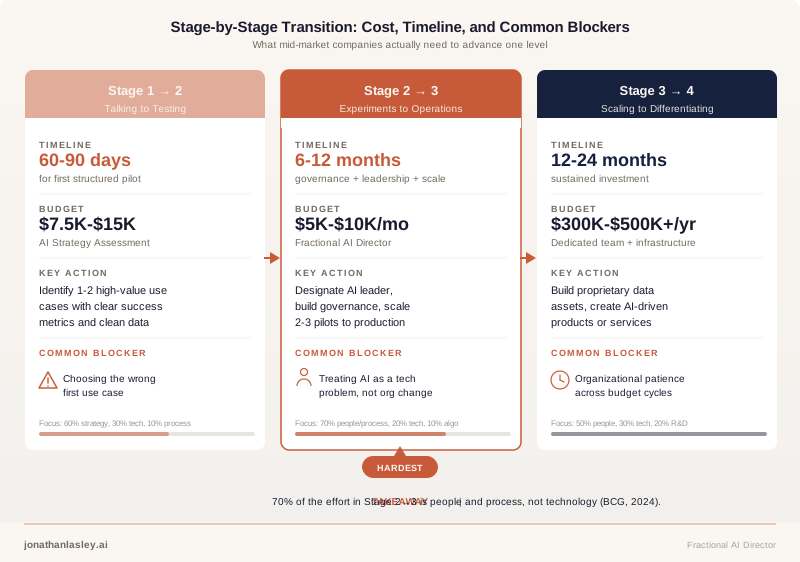
Knowing your stage is step one. The harder question is what it actually costs, how long it takes, and where companies get stuck when trying to advance. According to BCG's research (2025), only 5% of companies qualify as "future-built" for AI. The 95% that haven't aren't failing because of technology. They're failing because of people and process: BCG's data shows the investment split for successful AI scaling is roughly 70% people and process, 20% technology, 10% algorithms.
Stage 1 to Stage 2: From Talking to Testing
What happens: You pick 1–2 high-value use cases, run structured pilots with clear success metrics, and build the baseline data practices needed to evaluate results.
Timeline: 60–90 days for the first pilot. 90–180 days to establish repeatable pilot methodology.
Budget benchmark: $7,500–$15,000 for a professional AI Strategy Assessment that identifies the right use cases, builds a 90-day roadmap, and delivers a working prototype within two weeks. You walk away with proof that AI works in your environment, not just a strategy deck.
Most common blocker: Choosing the wrong first use case. Companies pick the most exciting AI application instead of the one with the cleanest data and clearest ROI. A good assessment prevents this by scoring use cases on feasibility and impact before you commit resources.
Stage 2 to Stage 3: From Experiments to Operations
This is the hardest transition, and it's where the majority of mid-market companies get stuck. You've proven AI works in isolation. Now you need to connect those isolated wins into an operational strategy with executive ownership, governance, and cross-functional coordination.
According to Gartner's AI Maturity Survey (2025), 91% of high-maturity organizations have a dedicated AI leader, compared to just 37% of low-maturity ones. High-maturity organizations also keep AI projects operational for 3+ years at a rate of 45%, versus 20% for low-maturity companies. The data is clear: leadership accountability is what separates companies that scale AI from those that stay stuck in pilot mode.
Timeline: 6–12 months to establish governance, designate leadership, and scale 2–3 pilots into production systems. The first 90 days typically focus on auditing existing AI initiatives, killing the ones that aren't producing measurable results, building a governance framework, and scaling the strongest pilot into a production system with clear KPIs.
Budget benchmark: $5,000–$10,000/month for a Fractional AI Director who provides the executive-level leadership without the $250,000+ cost of a full-time hire. This is the most cost-effective path for mid-market companies because you get strategic direction and hands-on implementation from someone who works in your systems, not just your slide decks. RSM's data confirms the pattern: 70% of mid-market companies needed outside help to integrate AI effectively.
Most common blocker: Treating AI as a technology problem instead of an organizational one. The 70/20/10 split (people/process, technology, algorithms) means your biggest investment isn't in tools. It's in changing how your teams work. Companies that hire a fractional leader to drive this change advance. Companies that buy more software don't.
I see this pattern consistently: the companies that break through the Stage 2 trap are the ones that put a person, not a platform, in charge of the outcome. That person needs to sit at the executive table, understand the business strategy, and have the authority to kill underperforming pilots while scaling the ones that work. Without that authority, Stage 2 companies accumulate AI experiments like unpaid invoices: technically present, operationally meaningless.
A phase-by-phase AI roadmap can structure this transition so you're not trying to solve everything at once.
Stage 3 to Stage 4: From Scaling to Differentiating
What happens: AI moves from operational improvement to competitive advantage. You build proprietary data assets, create AI-driven products or services, and embed continuous experimentation into your culture.
Timeline: 12–24 months. This is an ongoing investment, not a project with an end date.
Budget benchmark: $300,000–$500,000+ annually. At this point, most companies either build an internal team or maintain a fractional leader alongside specialized implementation partners. The comparison between fractional and full-time AI leadership becomes relevant here, as some Stage 4 companies outgrow the fractional model.
Most common blocker: Organizational patience. Stage 4 requires sustained investment across multiple budget cycles. Companies that cut AI budgets during a single slow quarter lose the compounding effect that makes Stage 4 valuable.
For the broader strategic context on building an AI program at this scale, the mid-market AI playbook lays out the full strategic framework.
Frequently Asked Questions
What is an AI maturity model and why does it matter for mid-market companies?
An AI maturity model is a framework that categorizes your company's AI capabilities into defined stages, from initial exploration to strategic differentiation. It matters for mid-market companies because 62% of organizations sit in the first two stages, where financial performance lags behind industry averages. Without a clear picture of your current stage, you can't identify the right next investment or avoid wasting budget on capabilities you're not ready for.
How do I assess my company's AI maturity level?
Score your company across five dimensions: strategy, data, governance, talent, and execution. Rate each on a 1–4 scale. Your overall maturity stage is determined by your lowest-scoring dimension, not your average, because one weak area creates a bottleneck that prevents scaling. The free AI Readiness Assessment provides a structured 3-minute version of this evaluation.
What does it cost to move from one AI maturity stage to the next?
Stage 1 to Stage 2 typically costs $7,500–$15,000 for a professional assessment that identifies the right pilot use cases and builds a 90-day roadmap. Stage 2 to Stage 3 runs $5,000–$10,000/month for fractional AI leadership over 6–12 months. Stage 3 to Stage 4 requires $300,000–$500,000+ annually for dedicated team resources and infrastructure. Each transition has a different cost profile because the bottleneck shifts from strategy (Stage 1–2) to organizational change (Stage 2–3) to sustained investment (Stage 3–4).
How long does it take to advance one AI maturity level?
Most mid-market companies can move from Stage 1 to Stage 2 in 60–90 days with a focused pilot. The Stage 2 to Stage 3 transition takes 6–12 months because it requires organizational changes beyond technology. Stage 3 to Stage 4 is a 12–24 month investment. The most common mistake is trying to skip stages or rush the Stage 2 to Stage 3 transition, which is where 70% of the effort involves people and process changes, not technology decisions.
Do mid-market companies need a dedicated AI leader to advance AI maturity?
The data says yes. Gartner's research shows 91% of high-maturity organizations have a dedicated AI leader, compared to 37% of low-maturity ones. That doesn't mean a $250,000+ full-time hire. A Fractional AI Director at $5,000–$10,000/month provides the executive-level accountability that Stage 2–3 companies need, at a fraction of the cost. RSM's data backs this up: 70% of mid-market companies needed outside help to integrate AI effectively.
Ready to Find Out Where You Stand?
Most mid-market companies overestimate their AI maturity by at least one stage. An honest assessment is the fastest way to stop guessing and start advancing.
Take the free AI Readiness Assessment to get your maturity stage in 3 minutes, or book a free 30-minute strategy call to discuss your specific situation and what the right next step looks like for your company.
